
The Truth of the Edinburgh Festival Fringe
As told by Producer, Wayne Ashall
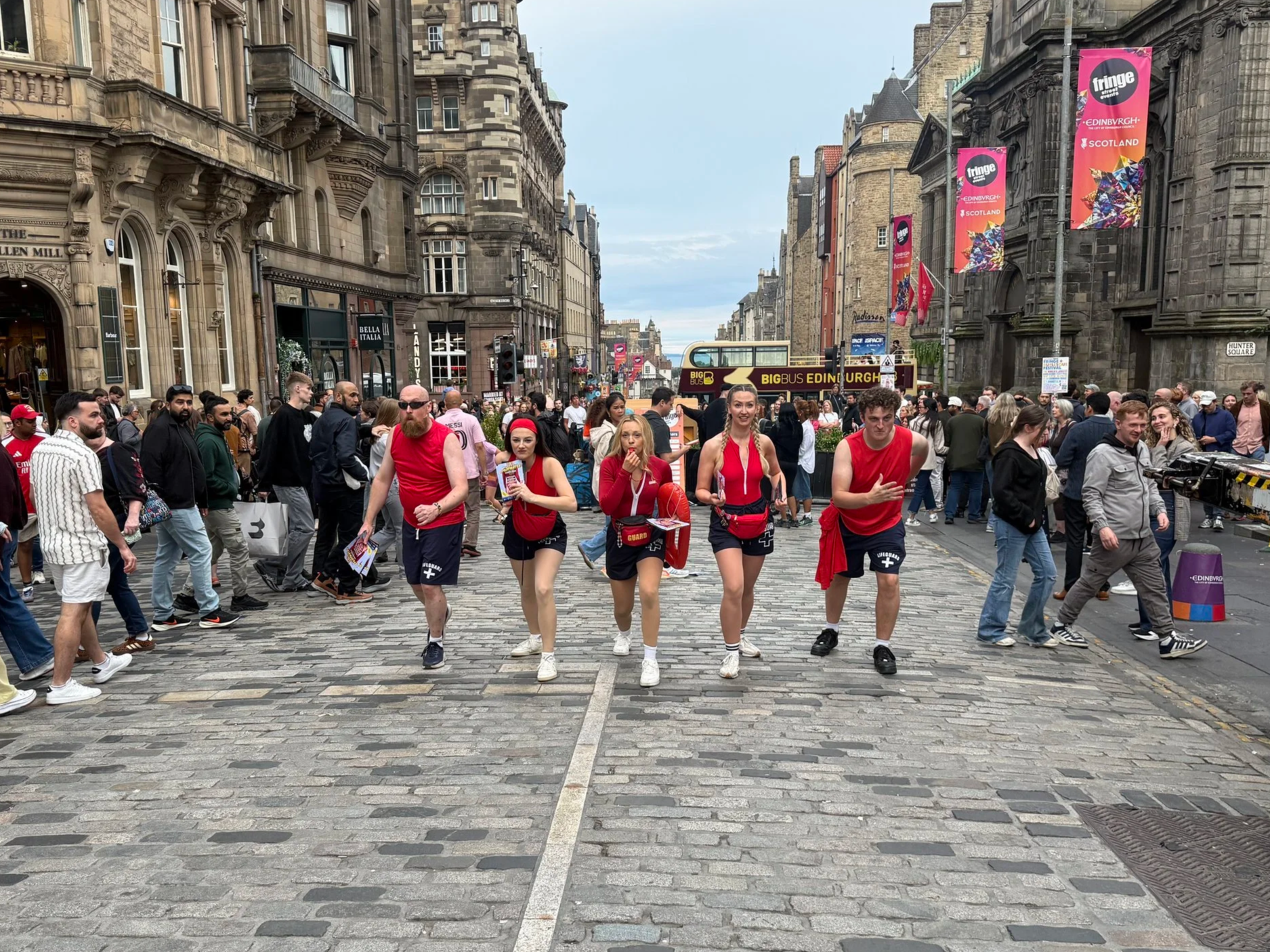
When I first sat down with the writer and director of Spraywatch: A Beautiful Rescue, Hywel Evans, I was excited to take the show to the next level and get as many eyes on it as possible. We knew we had the makings of an amazing product: a show that could be a success if we took the right next steps.
Despite some initial reservations, I talked Hywel into the idea of taking Spraywatch to the Edinburgh Fringe. Hywel’s main concern was the financial pressure this would place on me to fund the operation, but also the pressure it would place on him to dedicate enough time to the show to meet his own high standards, whilst managing existing work commitments.
What followed is, in fact, a story of success. However, after a few months, we realised that we couldn’t factor the financial outcome into our definition of success. We had entered a rigged game in which there was very little possibility that our show would ever have a chance of making a profit. Having networked throughout the festival, we now know we are far from alone in this.
Today is the 14th September 2026, and we have only just began to fully comprehend the whirlwind events of August. Here is a summary of some of the statistics and accolades that, I believe, make us an incredibly successful first-time Fringe show:
8 x 5★ reviews from accredited reviewers
9 x 4★ reviews from accredited reviewers
4 awards — Fringe Festival Gold Award, Theatre Village Satchel of Stars Award, Beyond the Curtain Best Musical, and Hive Mind: Best Ensemble
1,500 audience members — almost 70% of our total run capacity
8 sold-out shows
Over a quarter of a million social media views
42 pieces of news coverage with highlights including
Front cover of the Edinburgh Evening News
Page 3 of the Scotsman
MickeyJoTheatre preview
BBC Radio 2 Elaine Paige preview
60+ glowing audience reviews — not a single negative review
2 showcase invitations, including being named one of Merv Stutter’s Picks of the Fringe
The context of these achievements — having performed at theSpace on Niddry Street, rather than one of the “Big Four” venues — only makes what the team achieved more impressive.
So, let’s focus on the financials.
At this point, we will have spent approximately £28,000 in total to put this show on at the Fringe. And believe me, between our Excel spreadsheets and calling in favours from some unbelievable people, we have done this as cheaply as possible.
A couple of examples:
Our amazing sound and lighting engineer, Chris Osborne, not only gave up his time but also lent us the entire lighting and the majority of our sound equipment used for the run. We paid for his petrol and parking for his van to get the equipment to Edinburgh, and he slept on a camp bed in our apartment over the opening and closing weekends.
The apartment itself — five bedrooms for the entire cast, located near The Meadows just south of the city centre — was secured through a friend of a friend. We managed to get the whole month for just £5,000.
The five cast members received £300 each to cover rehearsal costs, with their accommodation and transport also paid for. The majority were able to work their full-time jobs remotely during the day, around flyering and performing the shows themselves.
So, our £28,000 should really have been well over £40,000 had we paid “market” accommodation rates and paid our talent what we believe they should have been paid — Equity minimum.
The total cost of everything that happened on stage — props, costumes, etc. — was less than £500.
£500: What the audience sees
£28,000: What it costs to make it happen
Despite all those savings, and countless other examples, as the sole funder, I stand to have lost close to £10,000.
So where did the bulk of the money go?
The Fringe Society, the venue, and marketing/PR.
Now, I have my own views on the value received from each of these categories. But the question is: when a show achieves such undeniable success, why should these establishments be the only ones to financially benefit?
Luckily, I view this investment as something bigger than the Fringe. We have launched Spraywatch onto a whole new platform. We are now speaking with venues across the UK about where to head next, and we have options to consider: how do we turn this success into something sustainable? Is there a route that enables that?
What worries me more than anything is this: what about the shows that didn’t have someone prepared to make that loss?
For every show like ours, I suspect there are another 20 that could have received 90+ stars from their first run, but they will never get the chance because they simply cannot afford it.
Hywel’s view on this is wider too.
People say, “Yes, but isn’t it great for the exposure you get?”
Exposure, and working for free, should only happen in a situation where nobody is making money.
If your kids get to sing in a choir at the local cathedral on a big, star-filled night, that is exposure. But if those kids were singing every night for a month, while the cathedral and other organisations were making millions, that would be exploitation.
There is a belief in our culture that the arts are “fun”. Making something great takes hard work and long hours. Vocation isn’t an excuse for free labour. But it often is in the media and arts.
Take the analogy into any other field — let’s say healthcare. It doesn’t stand up; in fact, it sounds absurd.
Doctors and nurses have strong vocational desires to do the work they do. But we wouldn’t build a private hospital making a hundred million pounds and say, “But the doctors and nurses will work for free, right? They love what they do, right? And hey, they could get some great exposure for their next job!”
So why do we accept this logic in the arts?
Whatever its original intentions, the Edinburgh Festival Fringe ecosystem now operates within a commercial model that places an enormous amount of financial risk on individual artists and producers. It has become a profit-generating machine.
Despite the Fringe Society's stats painting a bright picture for this year, tickets per performance were reportedly down 5% from 2025 and 9% from 2019 (thanks to @sambaintheatre for this analysis). You can also speak to almost any performer about the final week: it was quieter than ever.
A couple of massive weekend days appear to have been covering the lack of interest during the week, alongside the sharp increase in costs across the board for attending the festival.
I really hope the powers that be start to consider solutions to this.
Hywel has his own take on it:
“The equation is not difficult to work out. The hotels charge £300–£1,000 per night in August. The city has imposed a 5% tax. A tiny amount of those tens of millions is passed to the Fringe Society. But they earlier this year spent 8-million refurbishing their new offices.
There appears to be a huge amount of money being spent on the status quo of administration, and, as with all large organisations, the nature of those systems is to protect themselves — to keep those in a job who are in a job.
And this is not a criticism of their work. But it is quite simply an elephant riding a unicycle.
It is Disneyland where millions of tourists come and Mickey doesn’t get paid.
The council, the Fringe, the venues — each of them should consider what it would mean for the future of artists if a simple levy or pot was set up to share some of the money among registered shows, regardless of size.
1% of that hotel tax could make a huge difference to enabling shows to perform. It would also make a huge difference to artists’ ability to feel valued, welcome, want to return, and afford to do things like buy a sandwich.”
As we move away from the Fringe and start to look at options across the broader theatre industry, I am concerned that there is a similar positioning of risk.
One theatre we have already spoken to claims to work in the interests of new talent, providing financial packages that enable rather than inhibit producers. We were then offered a deal in which all of the upfront financial risk sits with us, with payments made from us to them, and with the hope of selling enough tickets to make a profit — a profit they would also share in.
The focus of this article is the Fringe, and I can only hope that others have had a different experience. I’m genuinely pleased for you if that’s the case.
We are learning as we go and will always be keen to develop our understanding of how others have grown from this point.
My guess would be: a lot of luck, knowing the right people, and a load of money to boot.
Will we return next year?
We’ll see, given time and the offers we receive.
A better question might be:
Would you?